Blog: Medical Council Research and Regulatory Data Insights Function
.png "Copy-of-Blog-banners-2026-(1)")
The Medical Council’s Research and Regulatory Data Insights function regularly produce high-quality research reports on the state of the medical workforce in Ireland. These reports are essential to informing recruitment and retention strategies, medical education and training development and healthcare policy in Ireland. They can support effective planning for a strong and sustainable medical workforce, and are used by the Department of Health to inform healthcare strategy.
The cornerstone of the Medical Council’s work in protecting the public is establishing and maintaining a Register of doctors. Under Irish law, no one can practise medicine in Ireland unless they are registered as a doctor with the Medical Council. Doctors register in one of six divisions of the Register, depending on the training they have completed, or are currently undertaking, and this should be commensurate with their status within the workforce. The Council also sets the standards for medical education and training in Ireland and oversees lifelong learning and skills development throughout doctors' professional careers through its professional competence requirements.
Through the annual registration process, the Medical Council collects data about every registered doctor in Ireland. This quantitative and qualitative data on registration includes insights into working arrangements, work role, hours worked, training status and county of practice. The Medical Council Research Division utilises this data to regularly produce high-quality research reports on the state of the medical workforce in Ireland.
The Research Division also supports research initiatives across teams in the Council and with our external stakeholders, including academics, Department of Health and NDTP.
Head of Research and Regulatory Data Insights
.png "Dr Bernadette Rock Head of Research")
Dr Bernadette Rock is Head of Research and Regulatory Data Insights at the Medical Council, where she contributes to developing and implementing its research programme and supporting functions across the Council. Previously, Bernadette worked in The Alzheimer Society of Ireland as Policy and Research Manager, where she developed and implemented a national dementia research strategy. Bernadette is keenly interested in supporting and empowering the patient/public voice in research. This is reflected in her research roles in The Alzheimer Society of Ireland, National Children’s Hospital and the Childhood Development Initiative. Bernadette is a graduate of Trinity College Dublin and University College Dublin, where she obtained a Masters in Sociology and Social Research and a PhD in Sociology.
Medical Council Research Project: Workforce Intelligence Report
Every year, the Medical Council produces a Workforce Intelligence Report which presents the analyses of the medical registration data gathered by the Medical Council through its annual registration retention process. It also draws on existing registration data to provide a cross-sectional overview of the retained doctors, new entrants, and voluntary withdrawals from the Register in any given year.
Spotlight on the 2022 Workforce Intelligence Report
The Medical Council recently published its Medical Workforce Intelligence Consolidated Report for 2022.
The bulletin-style report consolidates the most salient points from data taken from the Medical Council’s medical register (the ‘Register’). It presents analysis of data provided by all doctors who have registered for the first time or retained registration with the Medical Council, and those who have voluntarily withdrawn from the Register throughout 2022. This data on registration and divisional status and working arrangements is essential to informing medical training development, healthcare strategies and policy in Ireland.
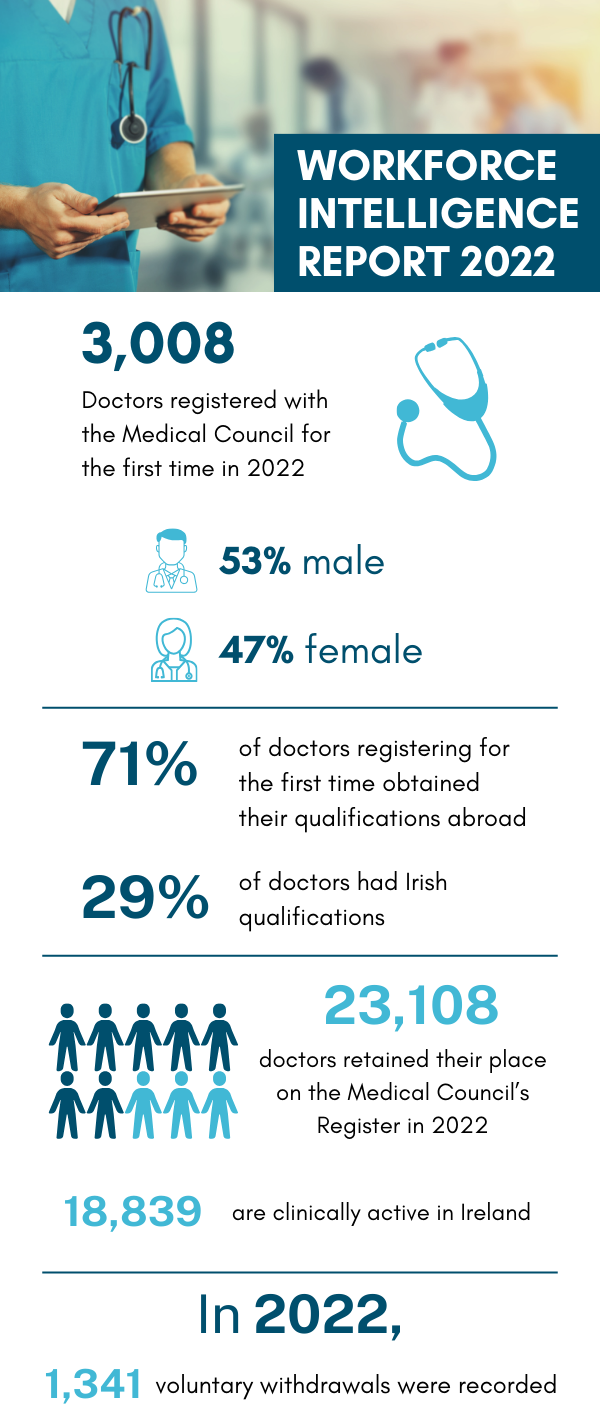
Analysis of registration and voluntary withdrawal data have highlighted key insights and issues that can inform strategic and integrated medical workforce planning. Concern for patient safety is at the core of the insights provided.
Workforce concerns - Reliance on Non Consultant Hospital Doctors (NCHDs) continues to be a feature of the Irish healthcare system and over-reliance on NCHDs to deliver care has implications for public protection safety. Ireland is also highly dependent on international medical graduates. The majority of NCHDs, not in training are international graduates and do not have access to specialist training in Ireland.
Workforce shortage - Consultant posts are not being adequately filled and this impacts on supervision and training for trainees and junior doctors. In order to have suitably trained applicants for new and replacement consultant posts, a sufficient number of consultants need to be trained and retained. Ireland also has an ageing General Practitioner (GP) workforce, and a substantial proportion of GPs are close to retirement age.
Non-compliance with European Working Time Directive (EWTD) - In 2022, over one-quarter of all doctors reported working more than 48 hours on average a week, in contravention of the EWTD. Of concern, over half of all trainee specialists reported working more than 48 hours per week. This has further serious implications for patient safety.
Doctor attrition - Acute doctor shortages within the Irish health system, especially at skilled and experienced consultant level, affect quality of care and can undermine patient safety. Family and personal issues, lack of training opportunities, inadequate resourcing and work conditions are all reasons for doctor withdrawal.
Commenting on the 2022 report, President of the Medical Council, Dr Suzanne Crowe said,
“Data on registration and divisional status, working arrangements, including work role, hours worked, training status and county of practise is crucial to understanding the state of the medical workforce during 2022, a period in which Ireland was finally emerging from the COVID-19 pandemic. Normality was starting to return to our health service – but our workforce was continuing to operate very much in crisis mode.
Medical Council-supported Research Programmes
Educating Healthcare Professionals for Climate Change Resilient and Sustainable Healthcare Systems
The Medical Council also supports research initiatives with external stakeholders, including academics. In January 2024, new health system research supported by the Medical Council was awarded funding by the Health Research Board. Professor Deirdre Bennett of University College Cork is leading the programme, ‘Educating Healthcare Professionals for Climate Change Resilient and Sustainable Healthcare Systems.’ The programme has been awarded €2,475,908.
With humanity facing a triple planetary crisis of climate change, pollution and loss of biodiversity, Professor Bennett’s research aims to prepare healthcare professionals to actively contribute to resolve the global planetary crisis. According to Professor Bennett,
“The outcome will be a healthcare system that is not only more responsive to climate challenges, but a contributor to broader sustainability goals, benefiting patients and the planet alike.”
Speaking about the project, Dr Bernadette Rock, Head of Research & Regulatory Data Insights at the Medical Council said,
“The Medical Council is delighted to bring its expertise and experience to this research by exploring how outputs might influence regulatory policy, and examining the best methods for integrating topics of climate change and sustainability into the professional development of doctors. One of the outputs of the planned research will be a competency framework applicable to all healthcare professionals, and the role of the Council will involve exploring how this framework can be integrated into the education and training of doctors from undergraduate through to continuing professional development".
You can read more about Medical Council research and reports in our "News & Publications" section on our website or should you have any specific research queries you can contact our team at research@mcirl.ie;