Blog: Safe Prescribing and Dispensing of Controlled Drugs (2026)
.png "Safe-Prescribing-and-Dispensing-of-Controlled-Drugs-(2)")
The Medical Council, in joint guidance with the Pharmaceutical Society of Ireland, have produced an updated version of the Safe Prescribing and Dispensing of Controlled Drugs guidance.
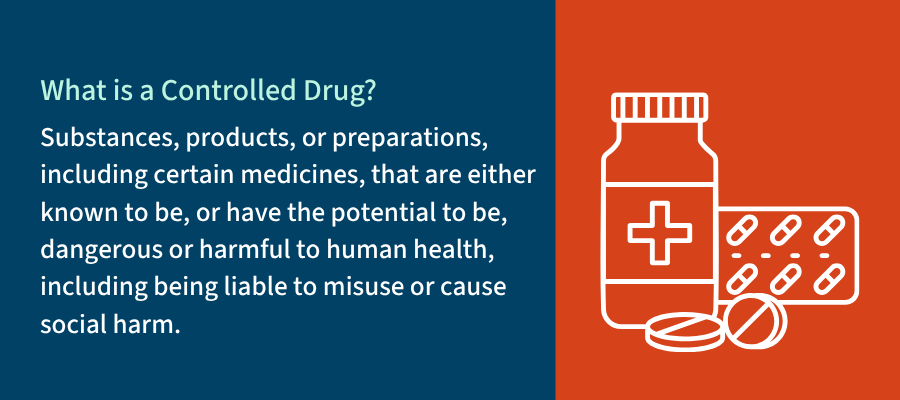
Controlled drugs are substances, products, or preparations, including certain medicines, that are either known to be, or have the potential to be, dangerous or harmful to human health, including being liable to misuse or cause social harm. These drugs are subject to control under the Misuse of Drugs Acts1977 to 2016.
The Misuse of Drugs Regulations categorise controlled drug substances into five schedules (ranging from the most tightly controlled in schedule 1 to the least tightly controlled in schedule 5).
The Safe Prescribing and Dispensing of Controlled Drugs resource aims to facilitate safer prescribing and dispensing of controlled drugs (CDs), with a particular focus on controlled drugs in schedule 2, 3 and schedule 4 part 1. It should be used by all prescribers and pharmacists in the collaborative, safe and effective care of patients.
This guidance was first produced in 2017 and has been updated in 2024 and again in 2026 to reflect further legislative changes. While this guidance provides some information on legal requirements applicable to hospital or residential settings, it is primarily aimed at professionals working in a primary care setting.
The guidance was updated in 2024 to reflect changes introduced by amendments to the Medicinal Products (Prescription and Control of Supply) Regulations 2003 (as amended), including changes relating to the emergency supply of schedule 2, 3 and 4 controlled drugs.
Additionally, the guidance was updated in light of changes introduced by the Medicinal Products (Prescription and Control of Supply) (Amendment) Regulations 2020. These changes introduced the electronic transmission of prescriptions, including those for controlled drugs, through the national electronic prescription transfer system, and established the legal requirements pertaining to prescriptions sent and received in this way.

Changes in prescribing regulations
In line with amendments to the Medicinal Products (Prescription and Control of Supply) (Amendment) Regulations 2020 legislation which commenced on 1 March 2024:
- Prescribers may issue prescriptions with a legal validity of up to 12 months where they deem it clinically appropriate.
- Prescriptions can be dispensed for up to 12 months from the date they are written where the prescriber has indicated this on the prescription. A prescription must not be dispensed more than 12 months after the date specified on the prescription.
- Furthermore, the legislation enables pharmacists to extend the validity period of prescriptions written for 6 months or more – up to a maximum of 12 months, providing the prescriber has not indicated otherwise. For example the prescriber defines the length of the prescription.
- This legislative change only applies to prescriptions written on or after 1 March 2024. This means that in practice, pharmacists will not be making decisions to extend or not extend prescriptions under the new legislation until on or after 1 September 2024.
.png "Pharmacist-Obligations-(2)")
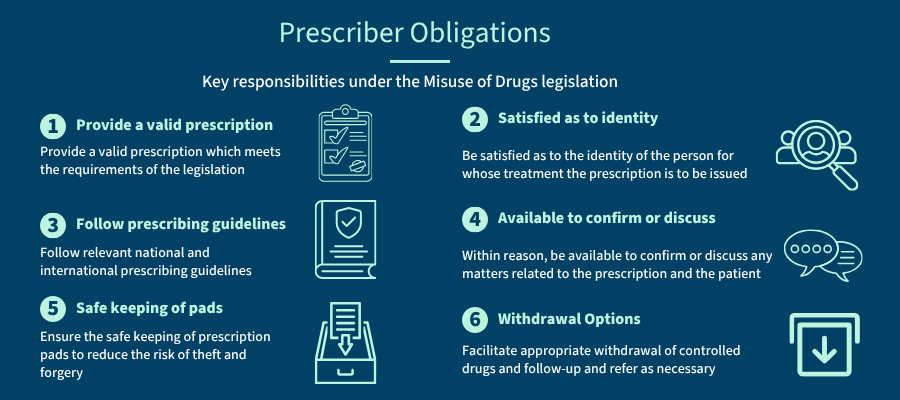
There is a strict system of control in place around the movement and supply of controlled drugs. In Ireland, these medicines are controlled by the Misuse of Drugs Acts and Regulations. These controls include restrictions on the people who can obtain or possess controlled drugs, and the strict legal obligations placed on pharmacists and prescribers charged with responsibility for the safe control of these substances. All prescribers (including doctors) and pharmacists must adhere to these regulations.
Read the latest guidance