Complaints Information for Doctors
The Medical Council regulates doctors in Ireland, safeguarding the health and safety of the public by ensuring high standards of professional conduct, performance, and skills among doctors. One of the ways we carry out this role is to look into complaints raised about the health, performance and conduct of individual registered doctors in Ireland.
This page provides helpful information and support for doctors going through the complaints process.
Please note, The Regulated Professions (Health and Social Care) (Amendment) Act 2020 ("2020 Act") commenced on 6 May 2025. If you are making a complaint after 6 May 2025, please visit our Regulated Professions Act 2020 page for information on how your complaint will be processed.
If your complaint was submitted before 6 May 2025, please see the existing complaint process information available below.
A complaint has been made against me
The Medical Council considers complaints from any person, including members of the public, employers and other healthcare professionals and we look into several hundred complaints every year.
It is important to note that between 80% - 90% of complaints which are opened and investigated, do not progress beyond the initial stage, which is carried out by the Preliminary Proceedings Committee. In these cases, as no concerns arise in relation to the doctor’s fitness to practise, the Medical Council is not required to take any action and the complaint is closed.
Where complaints are of a serious nature and raise concerns over a doctor's fitness to practise, the Medical Council will take action.
You can find more information on the complaints process below and what to expect at the different stages.
What to expect during the complaints process
When a complaint is made against you, we will notify you of the complaint in writing.
A Case Officer will be appointed to assist the Preliminary Proceedings Committee in dealing with the complaint. The case officer is your point of contact throughout the process and will keep you updated on the investigation and the outcome of the case.
The Medical Council’s Preliminary Proceedings Committee will assess the complaint and may decide to investigate the complaint. During the investigation stage, you are likely to be asked to provide information and/or documentation to us to assist the Committee in deciding if any further action is required. The Committee may also ask for other information such as patient records.
Depending on how complex the complaint is, it can take several months from the date we get the complaint to the Medical Council making a decision on what action to take. In all cases, we will try to deal with the complaint as quickly as we can.
For more detailed information and support, please see our guide here; What to do if a complaint is made about you.
Medical Council Complaints Process
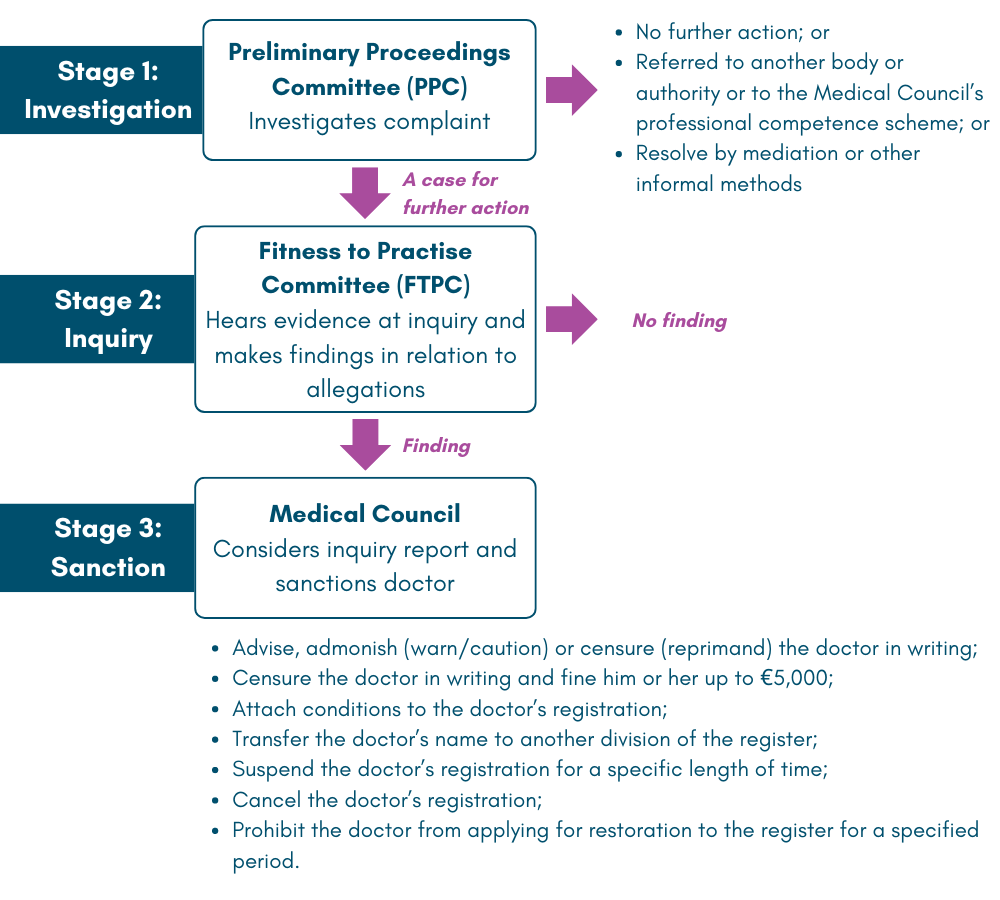
Complaints which are typically closed with no further action
Complaints that are not deemed serious and do not raise concerns over a doctor's fitness to practise or patient safety may be closed with no further action by the Medical Council. While this not an exhaustive list, these are some examples of such complaints;
Complaints which the Medical Council typically investigate
Where complaints raise serious concerns over a doctor’s fitness to practice, the Medical Council will conduct an investigation to assess potential risks to patient safety. While this not an exhaustive list, these are some examples of complaints the Medical Council typically investigate:
Outcomes of the investigation
When the Preliminary Proceedings Committee is satisfied that it has obtained the information it needs to assist them in assessing the complaint, it will decide what action, if any, needs to be taken.
The options available to the Preliminary Proceedings Committee are as follows:
Can I appeal the outcome of the investigation?
No, the decision made at the investigation stage of the process cannot be appealed. In certain circumstances, for instance if new information comes to light, a new complaint can be made. Where a new complaint is made, the PPC will consider whether it appropriate to carry out a new investigation.
Get independent advice
The Medical Council cannot give or arrange legal representation for you or give you advice on how you should respond to the complaint. We recommend that you obtain independent advice from your indemnifier or a legal practitioner to help you deal with the complaint.
Get support
We understand that having a complaint made against you can be stressful. If you need assistance during the complaint process, resources are available to provide practical and emotional support.
CAREhub
To support doctors, medical students, and individuals who are engaging with the Medical Council, we offer CAREhub - an independent, confidential, wellbeing support service provided by Lyra Health International. This service provides a safe space to speak with a qualified professional offering emotional and well-being support.
Other Supports
I have concerns about a doctor colleague
If you have concerns about a colleague’s conduct, competence or health you should, where you determine that it is safe for you to do so, first discuss your concerns with the doctor in question in a sensitive and discreet way.
If your concern relates to their health, you should encourage them to seek appropriate medical support and to avail of relevant support services.
If you do not consider it appropriate or safe for you to broach the concern yourself you should seek the advice of an appropriate person or authority e.g., a colleague, a manager or your professional body/ organisation. You should, to maintain appropriate confidentiality, consider anonymising the situation initially.
If you are concerned that a colleague may be putting patients at risk or is otherwise unfit to practise you must escalate those concerns in accordance with paragraph 3 (raising concerns).
Identifying and raising concerns
You must raise concerns where you believe that patient safety or care is being compromised by the practice of colleagues, or by systems, policies and procedures in the organisations in which you work.
Before doing so, you should consider seeking advice from an experienced colleague or from your medical indemnity organisation.
If your concerns are not resolved within the organisation, you should raise the issue with the relevant regulatory authority or through the applicable notification or disclosure pathways.
Can I make a protected disclosure to the Medical Council?
Under the Act, a “Protected Disclosure” is when a worker or employee discloses ‘relevant information’ which came to their attention in connection with their work, and they reasonably believe that it shows wrongdoing. Find out more information on the Protected Disclosures (Amendment) Act 2022.
How is my registration affected while the complaint in relation to me is being progressed?
You are still on the register and entitled to work as a doctor in Ireland while the complaint is being progressed, unless the Council applies to suspend your registration under section 60 of the Medical Practitioners Act 2007.
If the Medical Council has received a complaint about you, you will not be able to voluntarily withdraw your name from the register while the complaint is being progressed.
In addition, the Medical Council may not be able to issue you with a Certificate of Current Professional Status while there is an ongoing complaint about you.